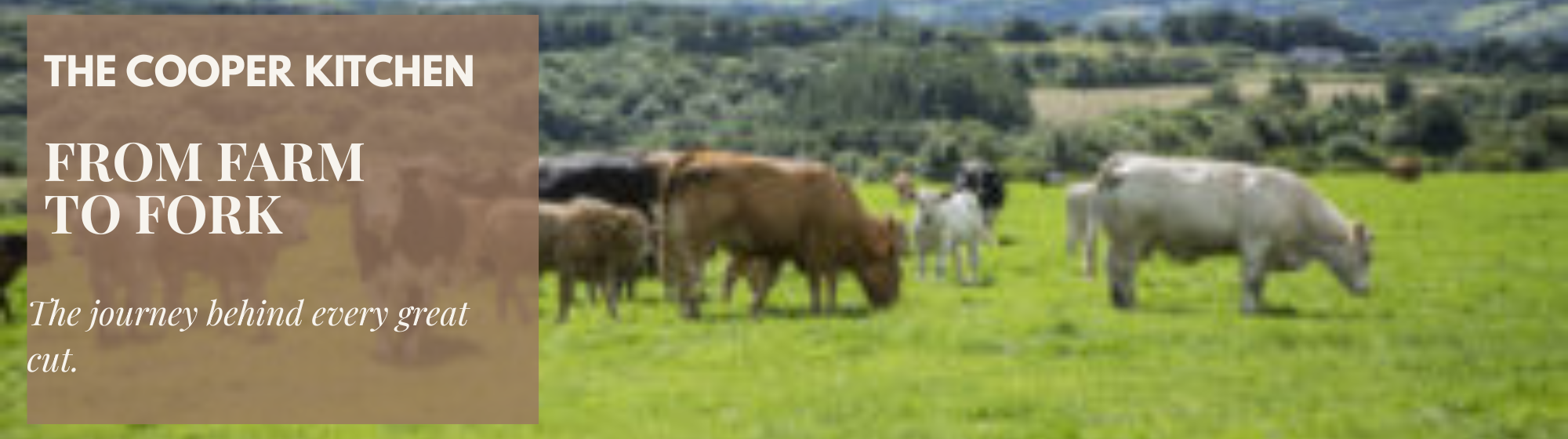
From Farm to Fork
The journey behind every great cut.
Every cut of meat on a butcher’s counter has a story that began long before it reached the shop.
It starts on the farm, with the people who raise and care for the livestock. From there comes careful selection, the journey through the livestock market and abattoir, maturation and finally the skill of the butcher who turns a whole carcass into the familiar cuts we cook at home.
It’s a journey involving farmers, buyers, abattoirs and butchers, with knowledge and experience playing a part at every stage.
And when you know that journey, you understand a little more about the food on your plate.
It Starts on the Farm
Great meat begins with good farming.
Long before an animal reaches the livestock market or butcher, farmers have invested time, knowledge and care into raising it. Breed, age, feeding, welfare and how the animal is managed all play a part in the quality of the meat further down the line.
For a traditional butcher buying whole animals, knowing the farms and farmers behind the livestock can be an important part of that relationship.
At Cooper Butchers, we work with trusted Scottish farmers and suppliers, including farmers we deal with directly. For lamb in particular, we regularly work with a farmer who knows the type, size and quality we’re looking for.
That relationship between farmer and butcher is where the journey really begins.
Choosing the Right Animal
The next stage is selection—and this is where experience really matters.
At a livestock market, a butcher isn’t simply looking for the biggest animal. Breed, age, weight, conformation, fat cover, the farm it has come from and how the animal looks on the day can all influence the decision.
Knowing what you’re ultimately trying to produce for the counter is important too. The aim is to select an animal that will provide the right balance of quality and usable cuts across the whole carcass to suit your customer base.
Traditional butchers may select livestock personally at market, work with experienced buyers who understand the type and quality they’re looking for, or build direct relationships with trusted farmers. Whichever route is used, experience and knowledge play an important part in selecting the right animal.
It’s a part of traditional butchery customers rarely see, but choosing a great cut can actually begin with choosing the right animal.
From Market to Butcher
Once livestock has been selected, the next stage of the journey is through an approved abattoir, where strict controls are in place for animal welfare, hygiene and food safety.
From there, the carcass makes its way to the butcher, where another important stage begins.
For many butchers, that journey can remain remarkably local. At Cooper Butchers, livestock purchased through the market is processed at Wishaw Abattoir, less than three miles from our production facility, before the carcasses arrive with our butchery team.
From this point, time becomes just as important as skill. Meat isn’t simply cut up as soon as it arrives—different species and different cuts benefit from being handled and matured in different ways before they’re ready for the counter.
And that’s where the butcher’s knowledge takes over.
Time Matters Too
Butchery isn’t only about how meat is cut. Knowing when it’s ready to be used matters too.
Different meats—and different cuts from the same animal—benefit from different periods of maturation. A cut destined for slow cooking doesn’t necessarily need to be treated in the same way as a steak intended for the grill.
For example, sirloin and ribeye back-eyes may be matured for around 21–28 days (or longer), allowing time for tenderness and flavour to develop before they’re prepared into steaks.
Other beef cuts may require less time, while lamb is generally matured for a shorter period. Fresh pork can move through the process more quickly again, with some cuts heading to the counter and others beginning a completely different journey through curing.
The important thing isn’t simply ageing meat for as long as possible—it’s understanding the cut, how it will be used and giving it the right amount of time.
Making the Most of the Whole Animal
Once the meat is ready, the whole carcass is broken down into the cuts we’re familiar with—but steaks and roasting joints are only part of the story.
Whole-carcass butchery is about finding the best use for every part of the animal. Some cuts become steaks and joints, others are ideal for slow cooking, while trim can be used for mince, sausages and other products.
Traditional cuts and offal have their place too. Offal can be used in products such as haggis, beef bones are sought after for stocks and bone broth, suet can be rendered into traditional dripping, and even cuts such as tongue can find their way into dishes like potted hough.
It also means the butcher has to think about carcass balance. The most popular cuts can’t simply be produced endlessly—every animal provides a limited amount of each.
That’s why not seeing a particular cut on the counter doesn’t necessarily mean it isn’t stocked. Sometimes it’s about preparing different cuts at the right time and making the best possible use of the whole animal.
It’s a way of working that respects both the animal and the food it provides.
Knowing Where Your Food Comes From
Running alongside every stage of the journey is something customers may never see: traceability.
From the farm an animal came from, through the livestock market and abattoir, to the butcher who prepares it and ultimately the point of sale, information follows the meat throughout its journey.
For a butcher, provenance isn’t simply about being able to name a country of origin. It’s about understanding the supply chain behind the product and being able to trace it back when required.
At Cooper Butchers, our meat can be traced through that journey right back to its source.
For the customer, much of that work happens quietly behind the scenes—but it provides something very important:
confidence in knowing where your food has come from.
From the Butcher’s Block to Your Table
By the time a cut of meat reaches the butcher’s counter, a remarkable amount has already happened.
A farmer has raised the animal. Someone with experience has selected it. It has travelled through the abattoir, been carefully matured where required and finally broken down and prepared by skilled butchers.
The final part of that journey happens at home.
Whether it’s a steak cooked for two, a slow-cooked family dinner or a Sunday roast shared around the table, every meal is the end result of many people doing their part well.
And perhaps that’s the real meaning of farm to fork.
It’s not simply about knowing where food comes from. It’s about understanding and appreciating the people, skills and care behind it.
A Journey Worth Knowing
Great meat doesn’t begin at the butcher’s counter. It begins much earlier, with good farming, careful selection and respect for the animal at every stage.
From the farmer who raises the livestock to the butcher who prepares the final cut, each person plays their part in the journey.
At Cooper Butchers, we’re proud to be one small part of that wider story—supporting Scottish farming, working with trusted suppliers and continuing the tradition of whole-carcass butchery.
Because knowing where our food comes from isn’t just about traceability.
It’s about appreciating everything—and everyone—that helped put it on our table.