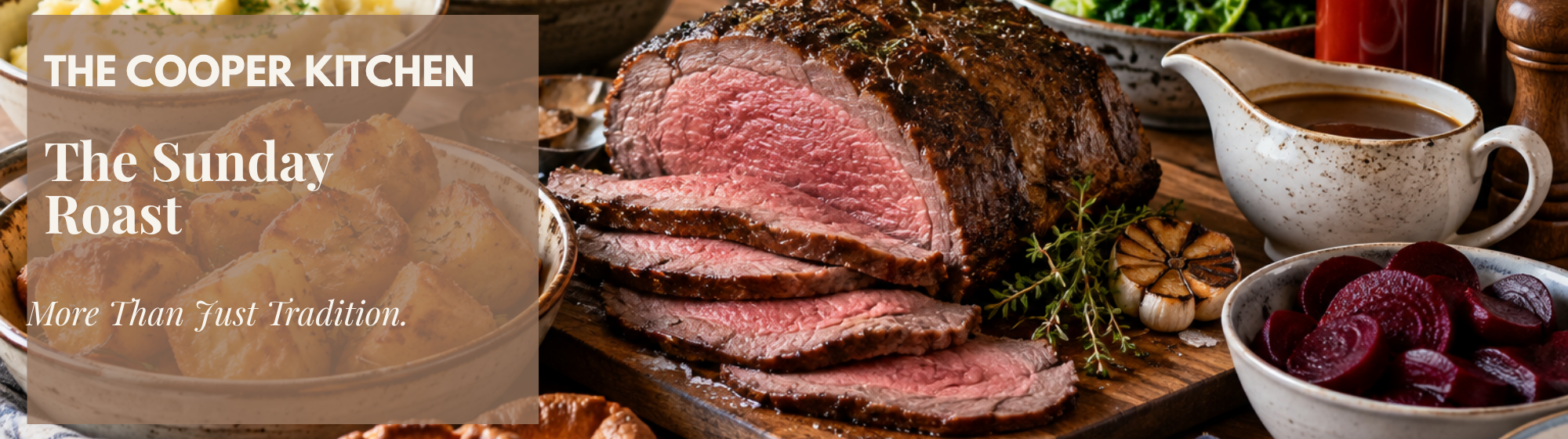
The Sunday Roast: More Than Just Tradition
Good food, a little time and one meal that still brings everyone to the table.
More Than Sunday Dinner
There are few meals quite as familiar as a Sunday roast. The smell of something roasting in the oven, potatoes crisping in the tray and everyone appearing in the kitchen to ask when dinner will be ready — for many of us, it’s tied up with memories of home and family.
Of course, Sundays don’t look quite the same as they once did. Families are busier, working patterns have changed and sitting down together for a big lunch every single week isn’t always realistic. Yet the Sunday roast has somehow held its place.
Perhaps that’s because it’s about more than what’s on the plate. Putting a joint in the oven, making the trimmings and gathering everyone around the table turns an ordinary meal into a bit of an occasion.
And while everyone has their own idea of what makes the perfect roast, a few simple choices — from picking the right joint to resting it properly — can make a surprisingly big difference.
This week in The Cooper Kitchen, we’re celebrating a meal that has lasted through generations, while sharing a few tips for making your next Sunday roast even better.
Choosing the Centrepiece
Beef, lamb, pork or chicken — there’s no single right choice for a Sunday roast. Each brings something different to the table, and sometimes the best place to start is simply with how many people you’re feeding and the kind of meal you fancy.
Beef is the classic choice for many, whether it’s a rib with plenty of flavour or a leaner roasting joint. It loves simple seasoning, roast potatoes, Yorkshire puddings and a good beef gravy.
Lamb brings a richer flavour of its own. Leg makes a wonderful centrepiece, while shoulder rewards slower cooking and becomes beautifully tender. Garlic and rosemary are classics for good reason.
Pork gives you the added prize of crisp crackling. Loin makes a neat, easy-to-carve roast, while shoulder suits a longer, slower cook and has plenty of flavour.
And then there’s chicken — perhaps the simplest Sunday roast of them all, but still one of the best. Roast it well with plenty of seasoning, herbs and a little butter and there’s very little it needs beyond good potatoes and vegetables.
Whatever you choose, don’t be afraid to ask your butcher how much you’ll need or which joint will best suit the way you want to cook it. Sometimes choosing the right cut is half the battle.
Before It Goes in the Oven
A good roast doesn’t need complicated preparation. In fact, some of the best results come from doing a few simple things well.
Start with seasoning. Salt and black pepper go a long way, then add flavours that naturally suit the meat — rosemary and garlic with lamb, thyme with chicken, mustard with beef, or fennel and sage with pork.
If the meat has been kept chilled, take it out while you prepare everything else rather than putting it straight from the fridge into the oven. Keep it covered and don’t leave it sitting out for long.
For pork crackling, make sure the skin is dry before seasoning it well with salt. Moisture is the enemy of good crackling, so taking a little time over this step is worthwhile.
And don’t forget the roasting tin. Onions, carrots, garlic and herbs underneath the joint don’t just add flavour while it cooks — all those browned bits and cooking juices left behind are the beginnings of a very good gravy.
Nothing particularly complicated. Just a little preparation before the oven does most of the work.
Getting the Roast Right
Roasting times are useful, but they should always be treated as a guide. The size and shape of the joint, whether it has a bone, and even the oven itself can all affect how quickly meat cooks.
A meat thermometer takes away much of the guesswork. Insert it into the thickest part of the meat, avoiding bone, and you can see what’s actually happening at the centre rather than relying entirely on the clock.
With beef and lamb whole-muscle joints, there’s room to cook them to your preferred level of doneness when the outside has been properly seared or cooked. Pork and chicken should be cooked thoroughly; for a straightforward home-cooking check, aim for a core temperature of at least 75°C.
Keep an eye on the outside too. If your joint is colouring more quickly than you’d like before the middle is ready, a loose covering of foil can help protect it while it finishes cooking.
And remember — the cooking isn’t quite finished when the joint comes out of the oven. What happens next is one of the most important, and most frequently rushed, parts of a good roast.
Give It a Rest
It can be tempting to start carving as soon as the joint comes out of the oven, especially when everyone is waiting for dinner. But giving the meat time to rest is one of the simplest ways to improve your roast.
As meat cooks, its juices move around within it. Resting allows things to settle before you carve, helping the meat stay juicy rather than losing those juices all over the chopping board.
Transfer the joint to a warm plate or board, cover it loosely with foil and leave it somewhere warm. A smaller joint might need around 10–15 minutes, while a larger roast can happily rest for 20–30 minutes.
And that resting time isn’t wasted — it’s the perfect opportunity to finish the potatoes and vegetables, get everything onto serving dishes and turn those roasting juices into gravy.
Then carve, bring everything to the table and enjoy the bit you’ve been waiting for.
Don’t Forget What’s Around It
The joint might sit in the middle of the table, but a Sunday roast has always been about everything that surrounds it too.
For many people, roast potatoes are non-negotiable. Parboil them first, give them a good shake to rough up the edges, then add them to a hot roasting tray with your chosen cooking fat. Those rough edges are what become wonderfully crisp and golden in the oven. Or perhaps you’re firmly in the buttery mash camp — smooth, creamy and perfect for soaking up plenty of gravy. And, of course, there’s absolutely nothing wrong with having both.
Then come the vegetables. Carrots, onions and a good helping of turnip — or neeps, as they should be called around here — alongside some greens with a little butter and seasoning. And no Scottish dinner table would look particularly out of place with a bowl of beetroot somewhere within reach.
Yorkshire puddings might traditionally belong alongside roast beef, but we’re not here to police anyone’s Sunday dinner. If you want one beside your chicken, lamb or pork, we certainly won’t argue.
Then there’s the question that can divide a table: tomato ketchup or brown sauce? Some will insist neither belongs anywhere near a roast. Others wouldn’t dream of eating one without their favourite. In our case, there’s at least one very firm vote for tomato ketchup — every time!
And finally, gravy. Those browned bits and juices left in the roasting tin are far too good to waste — but we’ll save the secrets of a really good gravy for next week’s Cooper Kitchen.
Try It This Way: A Proper Roast Beef Dinner
There are plenty of ways to build a Sunday roast, but sometimes you can’t beat the classics — good roast beef, crisp potatoes, buttery vegetables and plenty of gravy.
Serves 4–6
You’ll need:
- 1.5–2kg beef roasting joint
- Salt and freshly ground black pepper
- A little oil
- 1 onion, roughly chopped
- 2 carrots, roughly chopped
- A few sprigs of thyme
- 1 bulb of garlic, halved
- Potatoes for roasting
- Turnip for mashing
- Carrots and seasonal greens
- Butter
- Gravy to serve
Method:
Take the beef from the fridge while you prepare the vegetables and heat the oven to 220°C / 200°C fan.
Pat the beef dry, rub with a little oil and season generously with salt and black pepper. Place the onion, carrots, thyme and garlic in a roasting tin and sit the beef on top.
Roast at the higher temperature for around 20 minutes to get some good colour on the outside, then reduce the oven to 180°C / 160°C fan and continue roasting.
Rather than relying on the clock alone, use a meat thermometer to check the centre of the joint and cook the beef to your preferred level of doneness.
While the beef cooks, get the potatoes roasting until crisp and golden, mash the turnip with plenty of butter and prepare your carrots and greens.
Once the beef is cooked, transfer it to a board, cover loosely with foil and allow it to rest for at least 20 minutes before carving.
Use the resting time to finish everything else — including making your gravy from all those lovely juices and browned bits left behind in the roasting tin.
Carve the beef, pile everything onto warm plates and bring it to the table.
Tomato ketchup or brown sauce alongside it? We’ll leave that decision to you.
Whatever Sunday Looks Like
The Sunday roast has changed over the years, just as our Sundays have. It might be lunch around a busy family table, dinner after the kids’ football, something enjoyed with friends, or simply a good meal for two.
It doesn’t have to happen every week, and it doesn’t even have to happen on a Sunday.
What has lasted is the idea behind it — taking a little more time over a meal, putting something good in the middle of the table and sitting down to enjoy it together.
Whether yours comes with roast potatoes or buttery mash, Yorkshire puddings or none at all, beetroot on the side and perhaps a slightly controversial helping of tomato ketchup, there really isn’t one correct way to do it.
The best Sunday roast is probably just the one that feels like home.